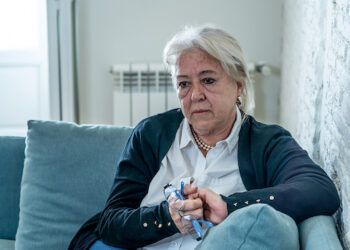

A new study by Count on Mothers (CoM), looked at understanding the experiences of mothers in the US. Count on Mother is an independent, nonpartisan research organization, and their study was part of Wave 1 of The National Benchmark of U.S. Mothers.
“We are concerned about what mothers are hopeful about and how they experience the world their children are growing up in,” study author Jennifer Brailsford told us. “Our goal is to share those experiences with change makers, for example, groups involved in policy development, advocacy, research, or education.”
Brailsford told us that often, the research teams conduct surveys with a topic in mind. These topics may be derived from current events, major policy shifts, or cultural and economic shifts. They then explore the literature to inform the survey questions.
“Our team is multidisciplinary with backgrounds in sociology, public health, and education, so our surveys are often informed by literature from several fields of study,” Jennifer Brailsford told us. “Throughout our background search and brainstorms about survey instruments, we often hypothesize what our findings may be based on our individual fields of study or our own experiences as mothers. However, we do our best not to lead the data with our expectations but let it speak for itself. Motherhood and parenting, along with society, are always shifting. One reason we developed the National Benchmark of US Mothers is to track those shifts over time.”
The research team at Count on Mothers was interested in understanding if any of these were shared experiences amongst mothers.
“Mental health is an incredibly important nuanced topic with variations throughout cultures and subgroups,” fellow study author Melissa Lawrence told us. “When discussing mental health with mothers, the concern is not just about their own mental health, but the health of their families and children.”
The research team asked mothers about their own mental health, the mental health of their children, their experiences with obtaining care, their access to care if needed, and the overlap between their own care and access and their children’s care or access. They then left open fields to allow mothers to expand on their experiences. When reviewing the data, they looked at each question individually, and then asked additional questions including whether the responses were true across the board, whether they changed according to the age of children, and whether the finding varied by the number of children and income.
The study yielded several results with a few that stood out among the others including when a family can’t afford all the healthcare it needs, it is the mother’s own care that gets set aside, not the child’s.
“This past year, 39% of mothers put off their own health or mental health care because of cost,” Lawrence told us. “That is three times the 13% who put off their child’s. And among mothers who cut care for only one person, it was their own, not their child’s, by about five to one. We also found that nearly 4 in 10 mothers (39%) say their child needed mental, emotional, or behavioral help this past year. Among them, 47% had difficulty getting it.”
When the researchers asked mothers what stood in the way of caring for their own mental health, the answer wasn’t what many people assume. Cost was a factor (16%), but time was the dominant barrier by a wide margin (49%). The research team found that difficulty doesn’t only mean the care isn’t available or affordable, often it means mothers simply don’t have time in the day to take care of themselves.
“I think most mothers wouldn’t be surprised to hear that many mothers set their own mental health aside in order to prioritize their chilren’s mental health, or that one of the most common barriers to caring for their own mental health was time,” Lawrence told us. “However, mental health experiences can feel individualized, and these results show mothers are not alone in these experiences.”
What did genuinely surprise the research team was the income pattern as access to care is often considered closely tied to income with the assumption being that the less a family earns, the harder it is to get care.
“Our results showed something more complicated,” Brailsford told us. “Difficulty accessing a therapist actually peaked in the upper-middle income group, not the lowest one. We understand this could be a benefits-cliff effect where families in that range often earn too much to qualify for assistance, but not enough to absorb the full cost of care without real strain. It’s a reminder that ‘high enough income’ doesn’t automatically mean enough room in the budget.”
Brailsford believes that taken together, these findings point to something that doesn’t show up in most existing data – a shortfall in care that’s largely invisible because it happens quietly, inside the home, before it ever reaches a clinic or a system that keeps records. A mother who skips her own therapy appointment to cover her child’s, or who says she simply doesn’t have the time, doesn’t generate a data point anywhere else. That’s exactly the gap this benchmark is built to fill.
“For policymakers and health systems, we think the income-squeeze finding is especially actionable,” Brailsford. “It suggests that eligibility cliffs for subsidized care may be doing real harm to families who are just above the line. For employers and insurers, the ‘time, not cost’ finding on maternal self-care suggests that flexibility (appointment availability, telehealth) may matter as much as coverage itself.”
Categories: Anxiety , Caregiving , Children | Tags: mothers, caregiving, anxiety
Patricia Tomasi is a mom, maternal mental health advocate, journalist, and speaker. She writes regularly for the Huffington Post Canada, focusing primarily on maternal mental health after suffering from severe postpartum anxiety twice. You can find her Huffington Post biography here. Patricia is also a Patient Expert Advisor for the North American-based, Maternal Mental Health Research Collective and is the founder of the online peer support group – Facebook Postpartum Depression & Anxiety Support Group – with over 1500 members worldwide. Blog: www.patriciatomasiblog.wordpress.com
Email: tomasi.patricia@gmail.com