Are rare sugars like allulose a healthy alternative to traditional sweeteners?
Allulose is a kind of low-calorie sugar that exists naturally in very small quantities but is now industrially produced as a commercial sweetener. It’s said to have advantages that make it comparable to erythritol as a sugar substitute. It’s also said to have anti-diabetic effects, but that study was on obese mice. Allulose decreases LDL cholesterol levels in hamsters fed a high-fat diet and is said to have a substantial impact on obesity in lard-munching mice, but what about men and women?
In a petri dish, allulose inhibits fat cell precursors from maturing into fat cells and reduces the amount of fat accumulation within fat cells. Below are before-and-after pictures when regular sugar was replaced with allulose; the fat is stained red. You can also check out the photos at 0:56 in my video Is Allulose a Healthy Sweetener?.
The researchers concluded that allulose might be a promising sugar substitute for an anti-obesity diet, but you don’t know until you put it to the test.
In another study, researchers gave people about a teaspoon of allulose a half hour before eating a meal. Compared to the no-sugar control group, the allulose group started burning more fat. The researchers concluded that allulose enhances after-a-meal fat burning, “indicating that it could be a novel sweetener to control and maintain healthy body weight, probably through enhanced energy metabolism.” First of all, it was only 15 calories of fat burned over that four-hour period. They didn’t burn more calories overall either. They just switched from burning carb calories to fat calories, and they may have switched back later and made up the difference over the course of the day.
We can’t just look at one meal—we need to track people’s actual weight over time. So, researchers set up a study comparing high-fructose corn syrup to the weight-reducing effect of a syrup that included about 5% allulose. The results showed significant decreases in body fat, body weight, and waist circumference with the syrup, but it was a proprietary mixture and, frankly, anything would look good against high-fructose corn syrup.
I found the study I’d been looking for: Researchers evaluated the effect of allulose for fat mass reduction in humans. More than a hundred people were randomized to a placebo control (sucralose) or a teaspoon of allulose twice a day, or one and three-quarter teaspoons twice a day. Despite no change in physical activity or calorie consumption between the two groups, body fat significantly decreased after allulose supplementation. Researchers even took CT scans so they could tell where the fat was disappearing from.
Now, the drop in body fat was only about two pounds over 12 weeks, and the drop in abdominal fat in the higher-dose group was almost totally a drop in subcutaneous fat, the flabby superficial fat, not the deeper, dangerous visceral fat that really matters for health. But still, the body fat loss despite no change in calorie intake was similar to what was seen in the mice. However, the hamster effect did not materialize—there was no significant change in LDL cholesterol in either of the allulose groups. What are the purported anti-diabetes effects?
If people chug a beverage with up to about two teaspoons of allulose alone or with a big load of rapidly digesting carbs, the allulose alone has predictably no influence on blood glucose or insulin concentration. Yet, when they consume allulose along with the refined carbs, there is actually a suppression of the elevation of blood sugar and insulin, and by a significant amount—a 30% drop in blood sugar and insulin levels over a two-hour period.
This may be because the presence of allulose impairs the absorption of sugar through the intestinal lining, because they all might be competing for the same sugar transporter. But who’s chugging maltodextrin? What about eating a regular meal? One study looked at people with borderline diabetes who could use some blood sugar spike suppression. A randomized, double-blind, placebo-controlled crossover experiment tested what drinking one and a quarter teaspoon of allulose in a cup of tea with a meal would do, and there was indeed a significant drop, though only about 15%.
The researchers also did a second experiment randomizing people to a little over a teaspoon of allulose three times a day with meals for 12 weeks. There didn’t appear to be any adverse side effects, but there also weren’t any weight loss effects in contrast with the other study. So, the body fat data are mixed, and so too are the sugar data. One study found no effects of allulose on blood sugars in healthy participants, though a similar study on people with diabetes did. A systematic review and meta-analysis of all such controlled feeding trials suggested that the acute benefit on blood sugars was of “borderline significance,” and it’s unclear whether this alone could translate into meaningful improvements in blood sugar control over time. So, maybe it’s not enough to just add allulose. You might actually have to also cut out the junk.
Although the ability to suppress blood sugar responses is the most well-studied aspect of allulose, I do want to cover just one last angle. Researchers found that allulose extends the lifespan of a tiny roundworm called C. elegans through a dietary restriction mechanism, even though the worms being studied ate the same amount of food as the control group. Two months in, just a few percent of the control group were still alive, whereas twice as many in the low-allulose group and about 25% in the higher-allulose group were still alive, as you can see below and at 5:53 in my video.
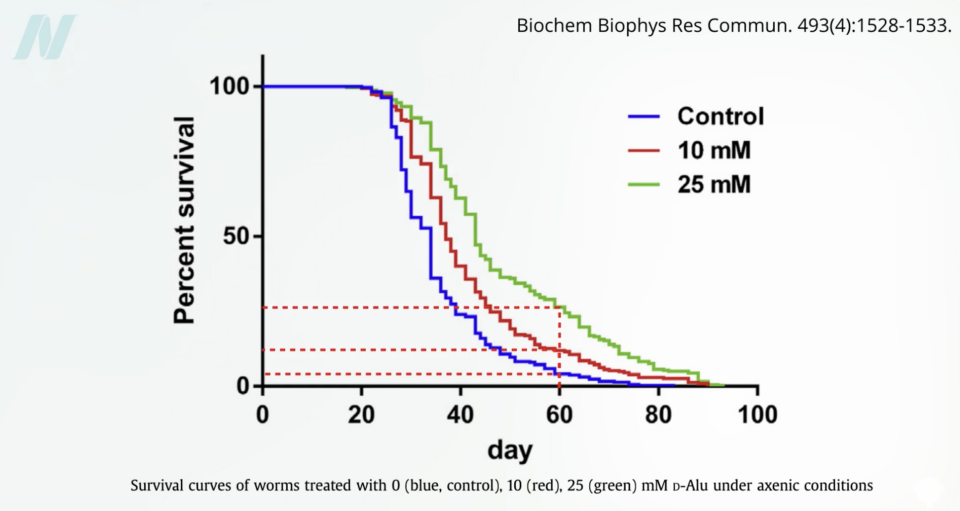
It may have worked by boosting the expression and activities of antioxidant enzymes in the body, extending lifespan by mopping up free radicals. But who cares about the survival curves of worms?
Well, C. elegans is a well-studied model of aging and longevity, mostly just for convenience’s sake, but it does share most of the longevity genes or pathways researchers are interested in. It would be nice to see experiments on human cells, at least, and here we go: A study looked at the effect of allulose on free radicals and oxidative stress in human coronary artery endothelial cells, the cells that line the inside of our arteries. Add a bunch of sugar, and free radical levels shoot up, but add the same amount of sugar along with some allulose, and it’s as if you never even added the sugar, as you can see below and at 6:41 in my video.
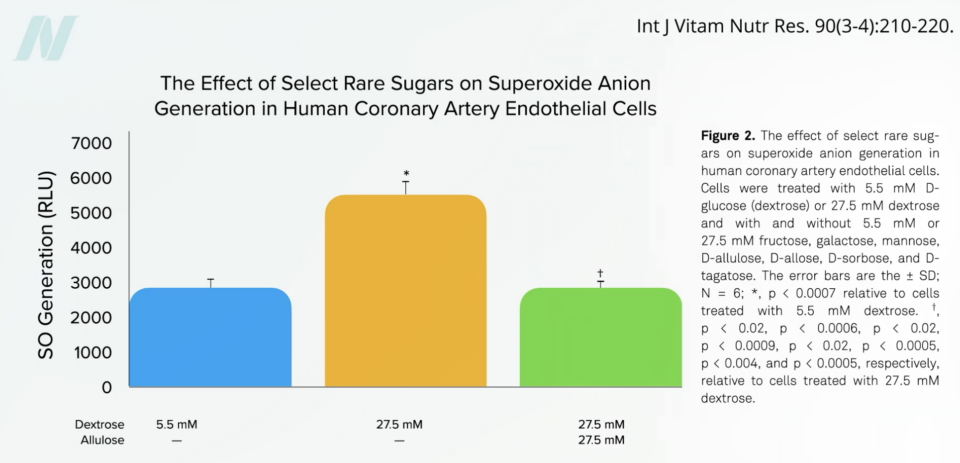
This then translates to inhibiting the expression of an inflammatory marker that plays a role in the buildup of atherosclerotic plaque. However, it’s still too early to make conclusions about the clinical relevance of these data.
So, are these rare sugars like allulose healthy alternatives to traditional sweeteners? Considering the variety of potentially beneficial effects of allulose without known disadvantages from toxicological and metabolic studies, “allulose may currently be the most promising rare sugar,” but how much is that saying? We just don’t have a lot of good data from human studies, therefore “it may be too early to recommend rare sugars for human consumption.”
Doctor’s Note
If you missed the previous blog, see Can Allulose Replace Sugar?.
The healthiest sweeteners are whole foods—fresh, frozen, or dried fruits like dates. Here is my simple (and delicious) recipe for date syrup.