Is potassium chloride a win-win by decreasing sodium intake and increasing potassium intake?
Of all the terrible things about our diets, high dietary sodium intake—high salt intake—is the leading risk. It’s estimated to be causing millions of deaths every year, killing mainly through adverse effects on blood pressure and increased risk of stroke, heart attack, and kidney damage. Hypertension (high blood pressure) is still called the “silent and invisible killer” because it rarely causes symptoms, but it’s one of the most powerful independent predictors of some of our leading causes of death.
We evolved eating a diet very rich in potassium and low in sodium, but today that pattern has been completely reversed. This flip reflects a shift away from traditional plant-based diets high in potassium and low in sodium—a shift away from fruits, greens, roots, and tubers—and a move towards salty processed foods stripped of potassium, which is considered a “nutrient of public health concern” because 98% of the U.S. population doesn’t even reach the recommended minimum daily intake. As I’ve mentioned previously, low potassium intake itself is implicated in high blood pressure and cardiovascular disease. However, few physicians actually consider telling their patients to eat more potassium-rich foods, like fruits and vegetables, to better control blood pressure, even though several meta-analyses have confirmed that high potassium intake appears to reduce stroke risk.
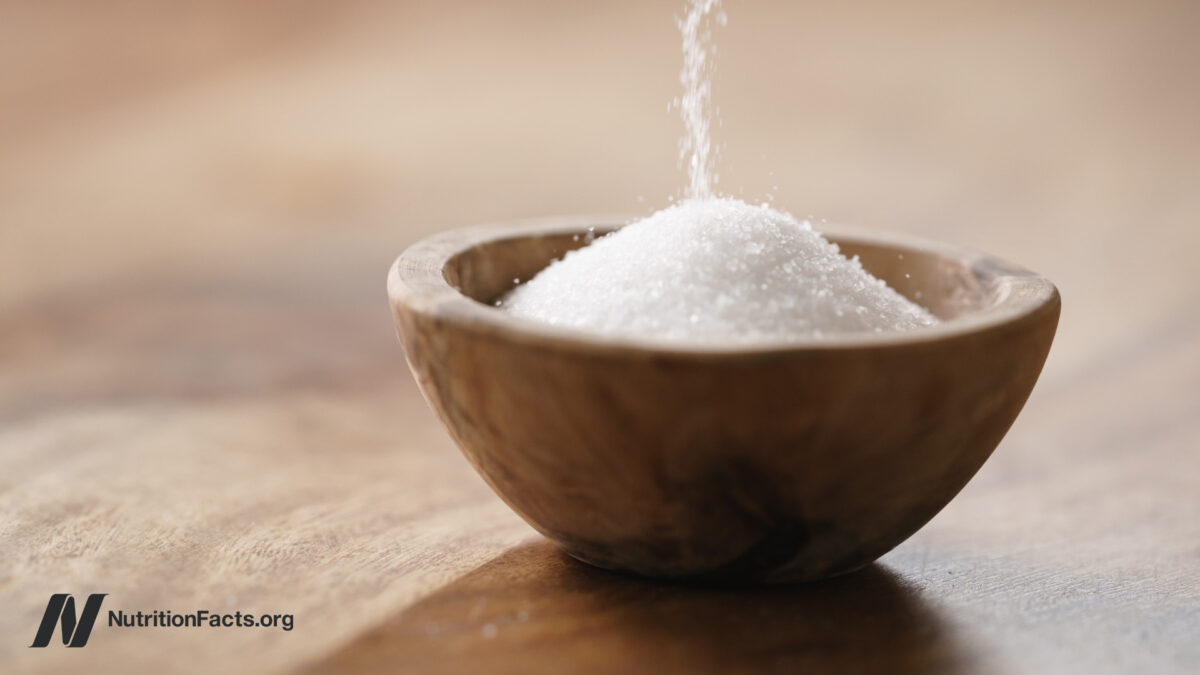
There is even a reduction in stroke risk independent of blood pressure effects, consistent with other protective effects of potassium, such as reducing clot formation, reducing arterial stiffening, and reducing the generation of free radicals. Higher sodium intake is associated with a 20% increased risk of dying prematurely, while higher potassium intake is associated with a 20% reduced risk of dying prematurely. Since sodium is found in junky processed foods, while potassium is concentrated in healthy foods like beans and greens, could having low sodium intake and high potassium intake just be a marker for a healthier diet—meaning more plant foods and less junk? How do we know sodium is cause-and-effect bad? Because randomized controlled trials show that sodium reduction leads to blood pressure reduction, just like randomized controlled trials show that if people are given extra potassium, their blood pressure can be lowered as well. So, what about using potassium chloride to salt your food, rather than sodium chloride? That’s what’s found in these zero-sodium salt substitutes, which you can see below and at 2:28 in my video Are Potassium Chloride Salt Substitutes Effective?.
Potassium chloride is considered a naturally occurring mineral salt, obtained in the same way as regular sodium salt. Since we get too much sodium and not enough potassium, this would seem to make potassium chloride a win-win solution.
Whole healthy plant foods would be the best way to increase potassium intake, especially since fruits and vegetables have all sorts of other good things in them. But we now have 10 studies, comprised of 11 randomized controlled trials, showing that just swapping in some potassium chloride for regular salt can lead to significant reductions in blood pressure in people with hypertension, suggesting that salt substitutes may even help prevent hypertension as well. We know that salt substitutes can lower blood pressure, but does it actually decrease the incidence of hypertension, and more importantly, disease endpoints like stroke and mortality? You don’t know until you put it to the test.
In a randomized controlled trial, households had their salt replaced with just a quarter potassium chloride. At that level, most people either couldn’t tell the difference or even preferred the salt with the potassium mixed in. But did it actually do any good? The use of even the quarter salt substitute was associated with cutting the risk of developing hypertension in half.
But what about actually following people out to see if there’s any change in the risk of dying from cardiovascular disease? Five kitchens in a veterans’ retirement home were randomized into two groups for about two and a half years, salting meals with regular salt or, unbeknownst to the cooks and the diners, a 50/50 blend of potassium chloride. Those in the half potassium group cut their risk of dying from cardiovascular disease by about 40% and lived up to nearly a year longer. The life expectancy difference at age 70 was “equivalent to that which would have naturally occurred in 14 [years],” meaning that just switching to half potassium salt appeared to effectively make people more than a decade younger when it came to risk of death. In a recent massive randomized controlled trial in China involving 600 villages and more than 20,000 people over five years, participants received either a salt substitute made of a quarter potassium chloride, or they received regular salt. Not only did the salt substitute reduce strokes, and cardiovascular events in general, but it also reduced the risk of death from all causes put together!
China is a perfect setting for this study because up to 75% of the population’s sodium intake comes from salt added in the home kitchen or dining room, whereas most sodium in the American diet comes prepackaged in the meat and processed foods we buy, though certainly the food companies could switch over themselves. Why haven’t they? And why haven’t more people embraced these salt substitutes if they work well and can taste just as good? We could be “Achieving the Benefits of a High-Potassium, Paleolithic Diet, Without the Toxicity,” says the title of a Mayo Clinic review. So, “Is Salt Substitution Ready for Prime Time?” a commentary asks. What about safety? There are convincing arguments about the benefits, but what about the risks, like the “inclusion of potentially fatal salt substitutes in the food supply”? Wait, what? We’ll talk about the potential downsides next.
Doctor’s Note
This is the second in a three-part series on salt and potassium. If you missed the first video, see The Mineral Intake Recommendations Only 1 in 6,000 U.S. Adults Meet. We finish the series with Are Potassium Chloride Salt Substitutes Safe and Effective?.
I talk about the randomized controlled trials for sodium in The Evidence That Salt Raises Blood Pressure.