The meat industry’s own study concluded that meat consumption increased the risk of cancer, heart disease, diabetes, and premature death.
A series of papers published in the Annals of Internal Medicine that “largely discounted all but the highest quality randomised studies…reached a conclusion directly contrary to the public health advice we’ve heard for years.” They suggested that we should continue our current consumption of red and processed meats. The authors based their exclusion of evidence on the so-called GRADE (Grading of Recommendations Assessment, Development, and Evaluation) criteria, which were mainly created for evaluating evidence from drug trials. We need randomized, double-blind, placebo-controlled trials for drugs, but the “strictness of these criteria will probably cause evidence for just about every dietary, lifestyle, and environmental factor related to chronic disease to be graded as ‘low’ or ‘very low.’ If the GRADE criteria were used to evaluate the evidence for other factors related to diet (such as low consumption of fruits and vegetables and high consumption of sugar-sweetened beverages), lifestyle (such as alcohol, physical inactivity, safe sex, and inadequate sleep), and environment (such as passive smoking and air pollution, none of the current recommendations on these issues would be supported by high- or even moderate-quality evidence.”
But even after ignoring major parts of the available evidence, they still found an association between meat intake and an increased risk of cancer—and not only cancer. They found that following diets lower in red or processed meat consumption may decrease risks for premature death, cardiometabolic disease and mortality (meaning the risk of getting and dying of diseases like heart disease and type 2 diabetes), and getting cancer and dying from cancer. Yet, they still concluded in their dietary guideline recommendations to “continue current unprocessed red meat consumption” and “continue current processed meat consumption.” Forget the whole premature death thing and everything about cancer, heart disease, diabetes—just keep eating your burgers and bacon.
So, these are “dietary guidelines developed by a self-appointed panel that are tantamount to promoting meat consumption, despite their own findings that high consumption is harmful to health.” How did they square that, contradicting the evidence from their own meta-analyses? There’s only one body of evidence, and they found the same risk that all the other reviews found. “So they’re not saying meat is less risky; they’re saying the risk… is acceptable for individuals.”
As I discuss in my video The Health Risks vs. Benefits of Meat Consumption, you do have to consider the risk and benefits. We covered the harms. “[Their] own data show that a moderate reduction in red and processed meat consumption…can reduce total mortality by 13%, heart disease mortality by 14%, cancer mortality by 11% and type 2 diabetes risk by 24%.” What are the benefits? “In short, omnivores enjoy eating meat.” Uh, okay. “Given peoples’ attachment to their meat-based diet, the associated risk reduction”—in our leading killers like cancer, heart disease, and diabetes—“is not likely to provide sufficient motivation to reduce consumption of red meat or processed meat…” So, therefore, eat up! In fact, they even say that the other dietary guidelines that suggest we limit meat consumption because of the cancer association “have paid little or no attention to the reasons people eat meat,” whereas they did a systematic review of preferences regarding meat consumption and found that people who eat meat “enjoy eating meat,” as you can see here and at 3:40 in my video. Quite the revelation, wouldn’t you say?
“Omnivores are generally unwilling to change their meat consumption,” even in response to health concerns, according to the panel. (The panel, you’ll remember, that had “generous support” of a group getting millions every year from the meat industry). The panel believed that for the majority of people, the desirable effects associated with reducing meat consumption—like lowering your risk of family-devastating cancer and heart attacks—“probably do not outweigh the undesirable effects,” like having to give up all that yummy meat. This is what led them to make their recommendation to “continue current consumption.”
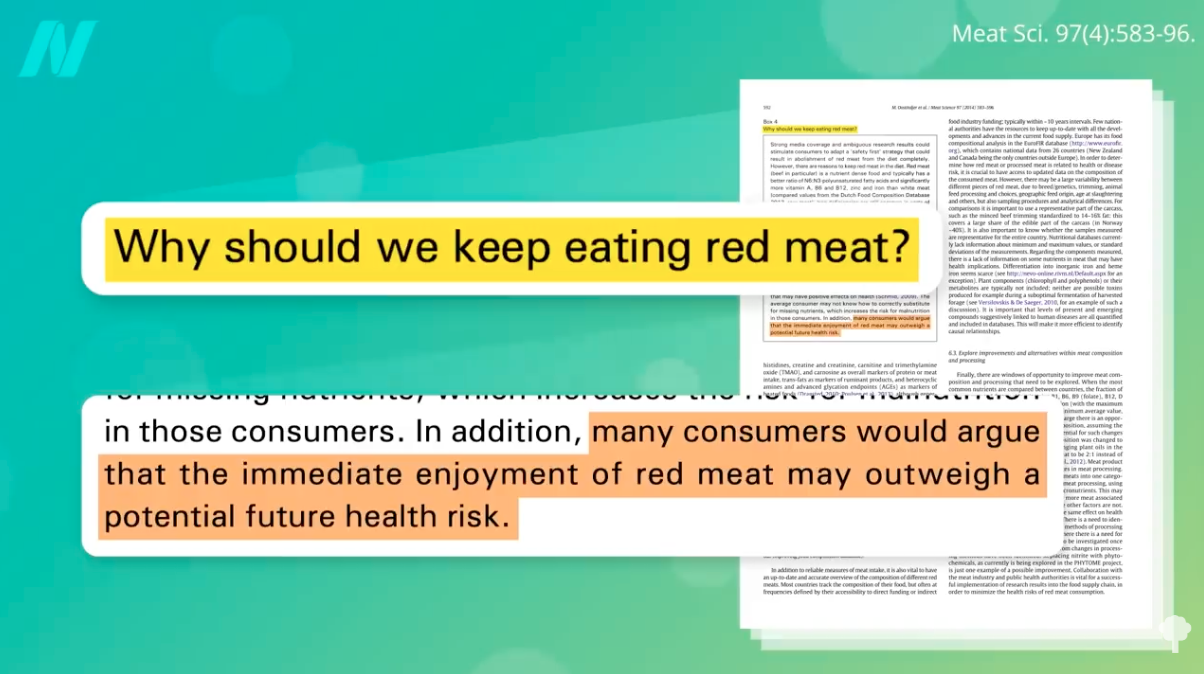
That sounds like something straight out of the journal Meat Science. “Why should we keep eating red meat?” Because of “the immediate enjoyment,” as you can see below and at 4:25 in my video.
Well, some people like smoking, drinking sugary sodas, and maybe having unsafe sex, too. “It’s kind of like saying: We know [motorcycle] helmets can save lives, but some people still prefer the feeling of the wind in their hair.” So, does that mean we should just tell people not to wear helmets?
Sounds foolish, but you’ll actually see this argument. “Complying with dietary recommendations therefore imposes a ‘taste cost’ on consumers,” so how about making “socially desirable recommendations that are most compatible with consumer preferences (i.e., that best balance health benefits against ‘taste cost’)”? Following that logic, “even if science told us that eating butter is unhealthy, its taste justifies the continuation of using it.”
What do you expect from NutriRECS, the meat industry–partnered panel that also published the paper criticizing the sugar guidelines, funded by the soda and candy industries?
NutriRECs aims to produce nutritional guideline recommendations based on the “preferences of patients.” What’s next, telling people to eat donuts and ice cream all day? Yet the Annals of Internal Medicine published the meat papers with a press release saying, “No need to reduce red or processed meat consumption for good health.” As Dr. David Katz, director of Yale’s Prevention Research Center, put it: Using the same methodology and rationale, they might as well have said, “No need to quit smoking for good health” or “No need to exercise for good health,” as shown below and at 5:49 in my video.
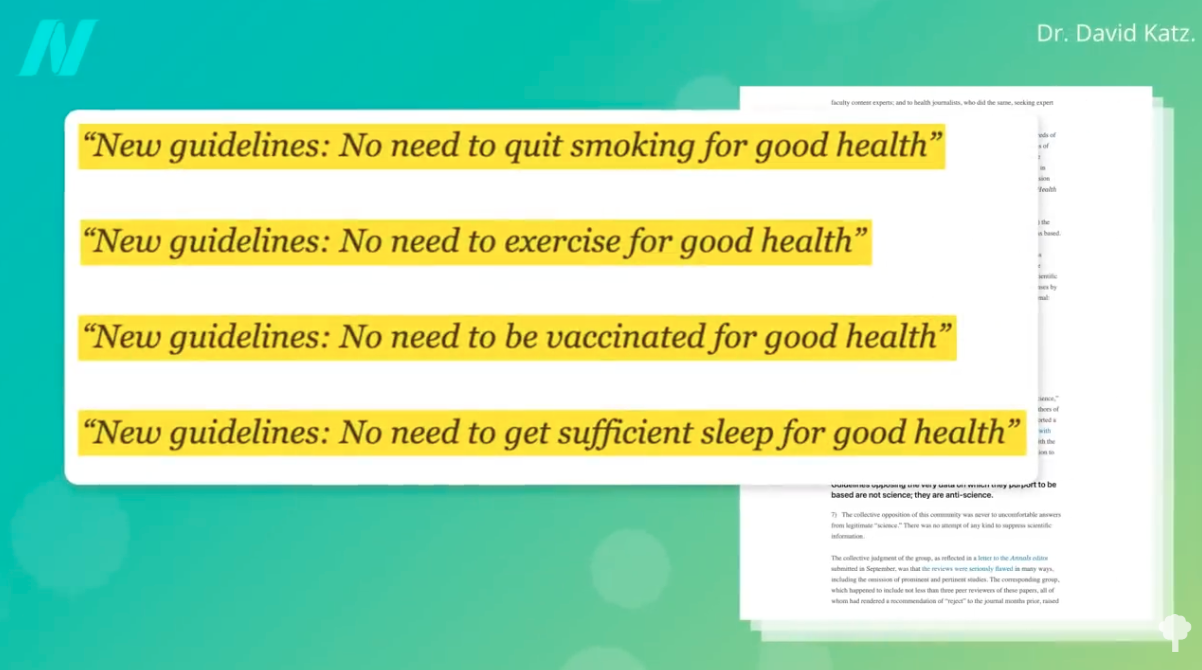
Said Dr. Katz, “Guidelines opposing the very data on which they purport to be based are not science; they are anti-science.”
Doctor’s Note
What do relative risk numbers actually mean? See, for example, How Much Cancer Does Processed Meat Cause?.
This is the sixth in an eight-part series on how industries impact dietary and health guidelines. The first five parts are in the related posts below.
The final two are How Big Meat Distorted the Evidence and How Many Minutes of Life Does a Burger Cost?.