
Why are Black Americans sicker and die younger than their white counterparts, and what can we do about it?
During the COVID-19 pandemic, the death rate for African Americans was as much as six times higher than that of white Americans. The higher Black pandemic deaths placed a harsh spotlight on their longstanding higher mortality and diminished longevity in general. “Unfortunately, diminished [African American] life expectancy predates the COVID-19 pandemic for decades.” The Black-white death gap for women is about three years, and for men, closer to five years.
The COVID-19 death disparities may have to do with “limited access to healthy food” in predominantly Black communities, “housing density, the need to work or else, the inability to practice social distancing,” but also the underlying “burden of ill health.” Increased COVID-19 mortality and complications occur more often in people with pre-existing conditions like hypertension, obesity, diabetes, and cardiovascular disease, comorbidities that are more common among African Americans. As you can see below and at 1:25 in my video How a Plant-Based Diet Can Help Reduce Racial Health Disparities, that means more high blood pressure, more diabetes, more strokes, and more likely to die at early ages from all causes put together.
The question is why? Why do “Black Americans live sicker and die younger than their white counterparts”?
One big factor is socioeconomic status. In the United States, race is closely tied to class, with African Americans about twice as likely to be living in poverty. On average, education levels are lower as well. However, even among African Americans whose socioeconomic status is comparable to that of white people, despite higher education and more socioeconomic resources, health outcomes are still poorer. Part of that has to do with lifestyle behaviors. For example, fewer than 5% of African American adults met physical activity guidelines. Smoking rates are comparable, though African Americans tend to be exposed to more second-hand smoke and have lower quit rates. This may be because they’re more likely to use menthol cigarettes, which enhance nicotine’s addictive potential. Why menthols? Because tobacco companies’ marketing for mentholated products targets African Americans, as you can see in the ads below and at 2:43 in my video.
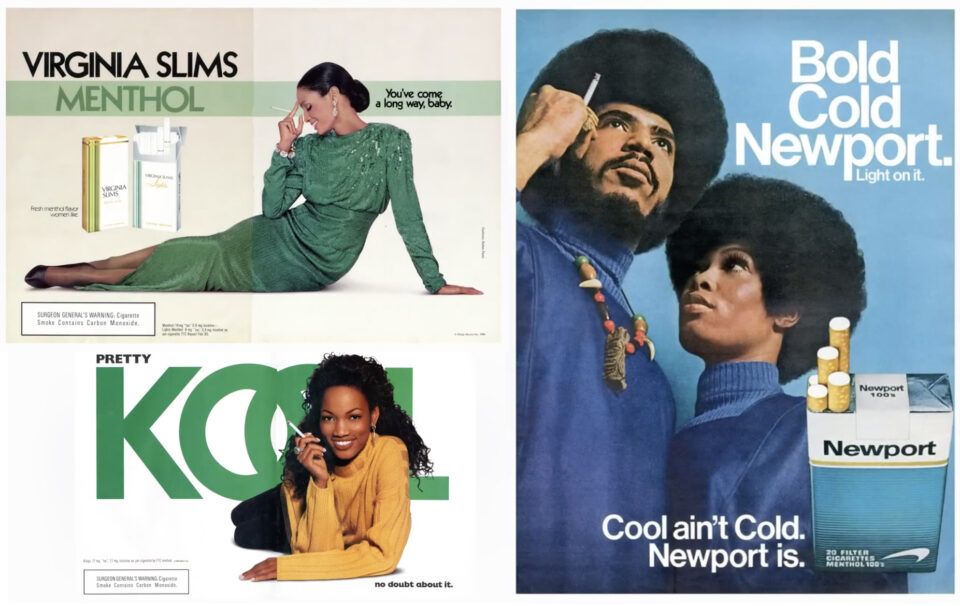
Black lives…Black lung.
Similarly, food messages on African American television shows reveal that not only does Black prime time contain more food commercials, but African American audiences may be receiving nearly three times as many ads for low-nutrient junk like candy and soda. That may be one reason why African Americans tend to consume fewer fruits and vegetables and are more likely to eat junkier foods. Of course, where are you going to get those fresh fruits and vegetables? There are fewer supermarkets in Black neighborhoods compared to white neighborhoods—as in, they have four times fewer supermarkets. What Black neighborhoods do excel in, though, is fast food. Predominantly Black neighborhoods have 60% more fast-food restaurants per square mile compared to predominantly white neighborhoods.
Now, of course, “dietary behaviors alone do not fully explain the significant differences in diet-related disease patterns between racial groups.” There are differences in employment, poverty, home ownership, and healthcare access, as you can see below and at 3:54 in my video.
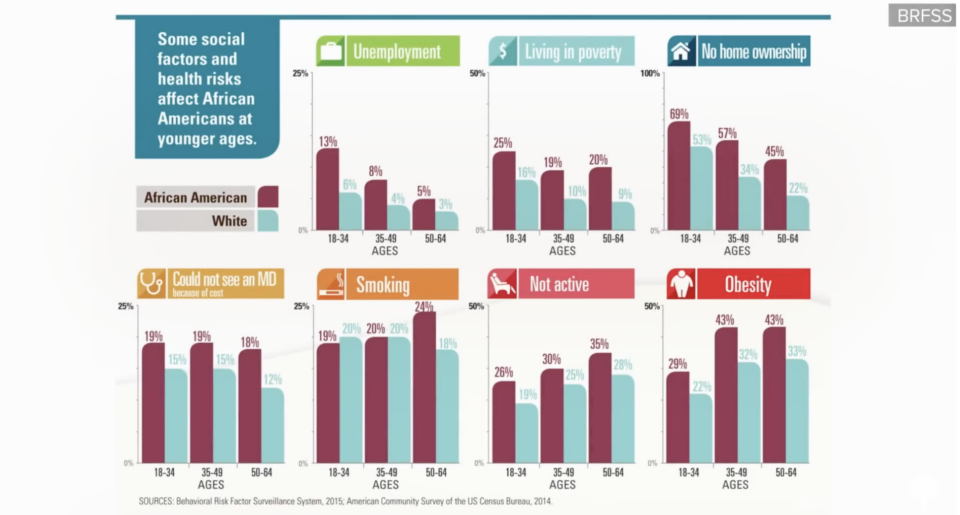
All of these factors can affect outcomes. But “[w]hile there are many social and economic factors such as racism and income inequality that contribute to health disparities, there is good evidence that simply eating a more plant-based diet could eliminate disparities in [cardiovascular disease] and diabetes.”
Here are the diabetes data. Even after controlling for education, income, physical activity, and Body Mass Index (BMI), non-Blacks eating strictly plant-based diets had 57% lower odds of diabetes. Among Black vegans, it was even more striking—70% lower odds. And that was after taking BMI into account. So, even at the same weight, Black vegans had 70% lower odds of diabetes than Black omnivores. The racial disparity is only about half that, at 36%. So, the increased risk of diabetes among Black participants was on the order of one-third, while the protection given by vegan diets in this subgroup was about 70%. Even just a vegetarian diet that includes dairy and eggs may more than counteract the racial disparity in diabetes risk.
And they are not the same weight. African Americans have higher obesity rates, cutting their lifespans by six years, but Black vegetarians and vegans have less than half the risk of obesity compared to those who eat meat. And this is after adjusting for differences in physical activity. So, even at the same exercise levels, those eating more plant-based had but a fraction of the obesity risk.
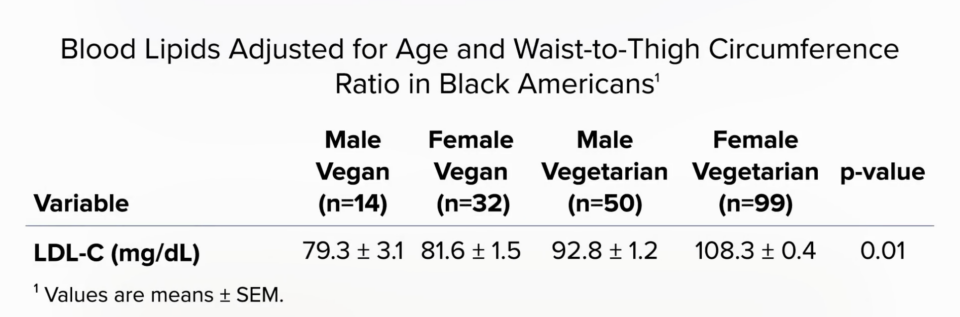
Then there is high blood pressure. In African Americans, hypertension is the most significant contributor to their increased cardiovascular disease burden and mortality. But Black vegetarians and vegans combined had 44% lower odds of hypertension, an important finding given hypertension is normally so prevalent in Black communities; no benefit was seen among those who cut out all other meat but continued to eat fish. The same thing was found for total cholesterol and LDL cholesterol: the odds were cut in half among Black vegetarians and vegans. “As with non-[B]lacks, these results suggest that there are sizeable advantages to a vegetarian diet in [B]lack individuals,” the researchers conclude.
What happens when vegetarians are compared with vegans? The study’s title gives it away: “Cardiovascular Disease Risk Factors Are Lower in African-American Vegans Compared to Lacto-Ovo-Vegetarians.” This is something we’ve known about when Caucasian vegans have been compared to vegetarians. However, it was not known whether African American vegans had a more favorable cholesterol profile until this study. The results showed significantly lower LDL cholesterol in vegans. Now, of course, the vegans were also significantly slimmer, with an average weight in the normal range, compared to the overweight vegetarians. But even after taking that into account, those eating more plant-based had significantly lower cholesterol, as you can see below and at 7:11 in my video.
So, plant-based diets have tremendous potential to promote health among Black people in the United States. In fact, they may have an even greater benefit. For example, African Americans have an excess burden of chronic kidney disease, not only because they have more high blood pressure and diabetes, but also due to genetic factors. Between 8% and 12% of African Americans are carriers of the sickle cell trait, which places them at significantly higher risk of kidney disease. While Black people represent a relatively small fraction of the U.S. population, they account for more than a third of all patients on dialysis due to chronic kidney disease. And that’s where plant-based diets can come in, shown to protect against both the development and progression of chronic kidney disease.
Three-quarters of Black people are lactose-intolerant, too, so they would stand to benefit even more from eating a plant-based diet. “It is unacceptable that for decades, the American healthcare system has failed African Americans and other minority communities in both primary and secondary [cardiovascular disease] prevention,” but that just makes it all the more important for them to take the reins of their own health destiny.
Doctor’s Note
Food and tobacco aren’t the only products with marketing targeted at Black Americans. I previously covered the dangers of Johnson & Johnson’s talcum powder in Talcum Powder and Fibroids.
For more information on this topic, check out this webinar hosted by the Plantrician Project: https://plantricianproject.org/global-health-disparities-a-dialogue.