What foods should we eat and avoid to reduce our risk of atrial fibrillation?
Atrial fibrillation, or Afib, is the most common clinical arrhythmia, meaning an abnormal heart rhythm, affecting millions of Americans and recognized as a global public health problem due to its “significant burden” of death and disease resulting from stroke, heart attacks, and heart failure. Is there any particular diet that may help prevent or treat it?
Recently, we learned what not to eat. Low-carbohydrate diets are associated with increased risk of developing atrial fibrillation for a variety of reasons. First, people on low-carb diets may be eating fewer anti-inflammatory foods like vegetables, fruits, and whole grains. “[R]educing intake of these anti-inflammatory foods may be one of the important mechanisms for the risk” of getting Afib. Second, a low-carb diet means increased protein and fat consumption, which may stimulate oxidative stress (the formation of free radicals), which has been shown to be associated with Afib. Finally, the effect might result from the increased risk of other cardiovascular diseases, which can set the stage for Afib. Indeed, low-carb diets are associated with an increased risk of overall mortality—dying from any cause—as well as specifically dying from cardiovascular disease and dying from cancer.
Dietary recommendations for patients with heart rhythm disorders are essentially the opposite of a low-carb diet:
- Fruits, vegetables, grains, beans, and nuts every day
- Seafood at most a few days a week
- Eggs, dairy, and poultry about once a week
- Other meats about once a month, in part to cut down on saturated and trans fats
You can see the recommendations below and at 1:39 in my video The Best Diet for Treating Atrial Fibrillation.
Whole food, plant‐based diets emphasizing whole grains, legumes (beans, split peas, chickpeas, and lentils), vegetables, fruits, and nuts and avoiding most (or all) animal products may play a special role, as they not only maximize protective foods, but they also exclude potentially harmful animal-based foods. For example, there’s persuasive evidence that avoiding certain foods like alcohol and dark fish may beneficially affect atrial fibrillation.
That finding about dark fish comes from the Framingham Heart Study, which classifies “dark fish” as salmon, mackerel, swordfish, bluefish, and sardines. In an exploratory analysis, researchers found that participants who consumed more than four servings of dark fish a week had about a whopping sixfold higher risk of developing Afib, though the intake of fish in general didn’t seem to have any effect.
It’s unclear exactly why alcohol is so bad when it comes to arrhythmias, but each drink per day may be associated with as much as an 8% increase in the relative risk of Afib, though drinking coffee or caffeine in general does not seem to be related to arrhythmia risk.
Where plant-based diets really shine, though, is in Afib risk factor management. “Plant‐based diets may reduce the likelihood of many traditional risk factors that are associated with [Afib], including hypertension, hyperthyroidism, obesity, and diabetes.”
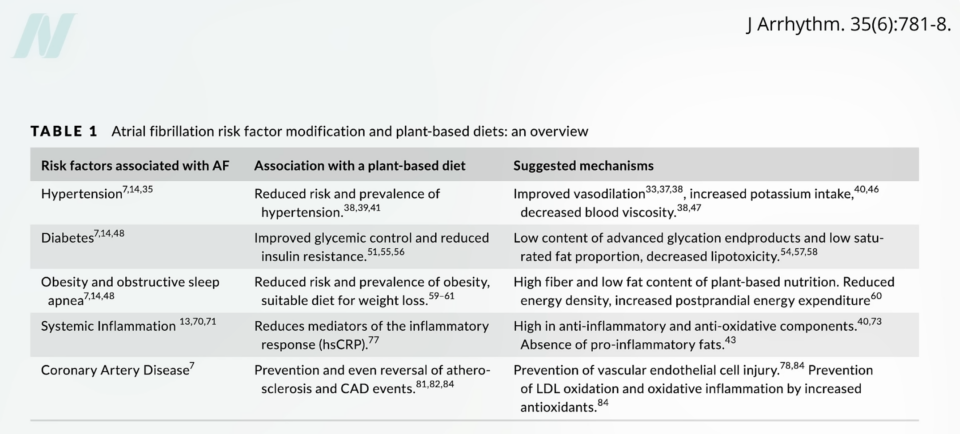
High blood pressure is one of the major risk factors, accounting for about one-fifth of all new cases of Afib. This is where a plant‐based diet can come in—it can improve vasodilation (the ability of the arteries to expand naturally), provide anti‐inflammatory and antioxidant effects, increase potassium intake, and decrease blood viscosity (or sludginess).
In terms of hyperthyroidism, excluding all animal foods from one’s diet was associated with half the prevalence of hyperthyroidism compared with those who eat meat, while vegetarian and fish-only diets were associated with intermediate protection.
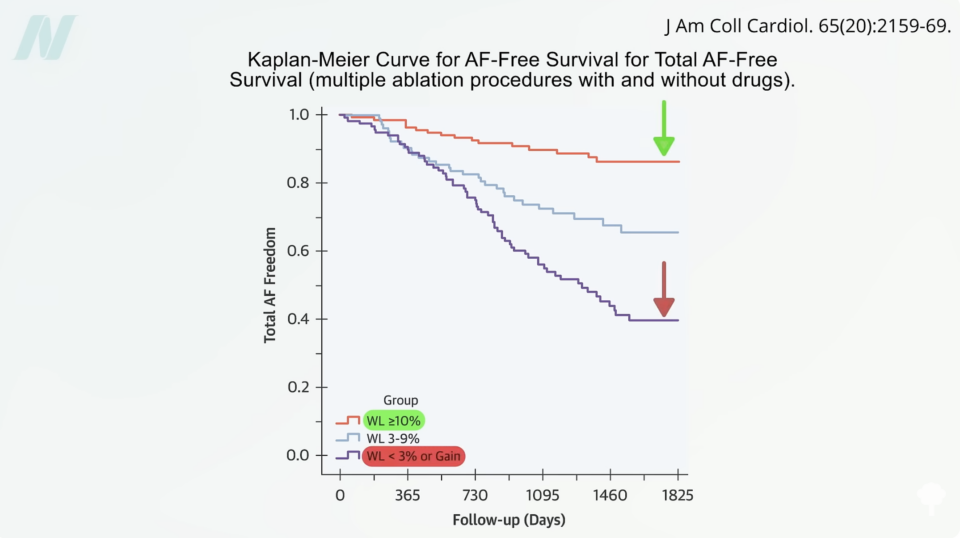
Having excess body fat may be responsible for about another fifth of all Afib cases, but the good news is that significant weight loss is associated with a sixfold greater freedom from atrial fibrillation. As you can see below and at 4:32 in my video, among overweight participants with Afib, those who lost 10% or more of their body weight had only a 10% chance of still having Afib five years later. In contrast, those who lost less than 3% of their weight—or gained weight—were 60% likely to still have Afib.
As you can see below and at 4:38 in my video, these are all the atrial fibrillation risk factors that can be prevented, arrested, or even reversed with a healthy enough plant-based diet: high blood pressure, type 2 diabetes, obesity, systemic inflammation, and heart disease.
“In light of these findings, dietary modifications are of paramount importance.” But you don’t know if they could actually cure atrial fibrillation until you put it to the test.
Unfortunately, all we have are case reports, but this one is quite compelling: an 82-year-old man with polypharmacy—meaning on a bunch of different medications, due to coronary artery disease, a history of heart attacks, ischemic cardiomyopathy, high cholesterol, high blood pressure, and persistent atrial fibrillation—who presented with cognitive impairment, memory loss, fatigue, and weakness. Now, if you’re not going to change the diet and lifestyle that led to all the problems in the first place, then drugs can certainly be better than nothing. Yet, commonly used blood pressure and cholesterol-lowering medications actually provide little absolute risk reduction and pose significant risk of adverse effects, as I’ve talked about before. So, this man decided to start treating the underlying cause. He started a whole food, plant-based diet with moderate physical activity, resulting in a rapid reduction of high blood pressure and high cholesterol and the discontinuation of antihypertensive, statin, and beta-blocker drug therapy. The patient also reported a reversal of impaired cognition and symptoms linked to atrial fibrillation and ischemic cardiomyopathy, including fatigue, light-headedness, and weakness.
Check out his results below and at 6:41 in my video.
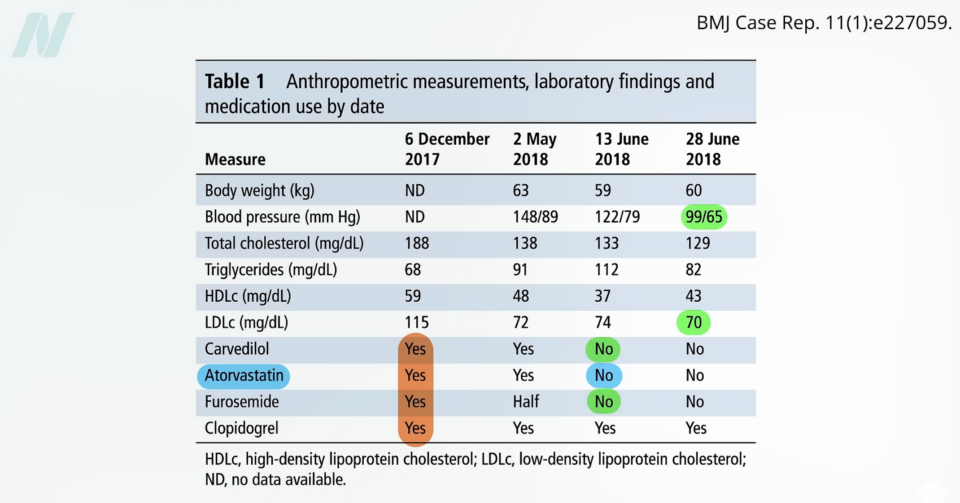
After adopting a healthier diet for about three months, his LDL cholesterol dropped by 37%, falling from 115 mg/dL to 72 mg/dL. You might point out that he was still taking cholesterol-lowering statin medication at that time, but even after his doctor discontinued the statin and blood pressure medications, his cholesterol remained low and his blood pressure completely normalized. What happened to his atrial fibrillation? Completely resolved.
Here’s how the patient described it. “In December 2017, I suffered a near-fatal heart attack and was rushed to the hospital. I immediately had a stent put in. The following day, I was prescribed a number of drugs to manage my condition. My brain fog got worse and I felt tired all the time…I decided enough was enough. I had already lost four years of my life to medication-induced brain fog. I wasn’t going to sacrifice more.” He had been eating a wholesome Mediterranean diet, but he was then educated on the benefits of cutting out meat, cheese, oil, and wine and eating more fresh vegetables. “I now have the strength to lift weights and walk and run on the treadmill an hour every day. I feel more alive than I have for years. I wake up each morning with a clear head and happy heart, grateful to not have to take a handful of drugs. Even though I’m not perfect with my diet, I’ve seen huge benefits from eating this way. My blood tests have shown remarkable improvement, which keeps me motivated to stay on track.” Because of his improvement, his cardiologist suggested he could stop taking his last remaining medication. “Eating this food gave me an opportunity to reclaim my health.”
Doctor’s Note
This important blog is a long time coming. In previous videos on Afib—Red Fish, White Fish; Dark Fish, Atrial Fibrillation and Omega 3s, Prostate Cancer, and Atrial Fibrillation—I only touched on the fish connection.
I previously reported on the dangers of low-carb diets in:
The video I mentioned about the risk of medications is Why Prevention Is Worth a Ton of Cure.